

『Refrigerant Flow Meter for HVAC System: Balancing Large Commercial Climate Loops』Related information(clamp on meter|electromagnetic meter|venturi meterrotameter|orifice meter|ultrasonic flow meter|mass flow meter|coriolis mass flow meter|coriolis flow meter|magnetic flow meter|magmeter flow meter|magflow flow meter|mag meter flow meter|electromagnetic flow meter|vortex flow meter|turbine flow meter|thermal mass flow meter|thermal flow meter|rotameter flow meter)
Refrigerant Flow Meter for HVAC System: Balancing Large Commercial Climate Loops
Quick Answer: A refrigerant flow meter helps you balance large chilled water or VRF climate loops by measuring real time mass flow rate. For liquid refrigerants like R134a, R410A, and R407C, Coriolis mass flow meters deliver high accuracy directly in kg/h without density or temperature compensation tricks. Silver Automation Instruments supplies inline Coriolis and vortex meters with 4-20 mA HART output, ATEX Zone 1 options, and 316L wetted parts ready for field installation.
Why Direct Refrigerant Flow Data Changes Chiller Control
Most building management systems rely on pump curve extrapolation or energy balance estimates. That approach hides uneven distribution across chiller evaporators and fan coil units. A dedicated refrigerant flow meter installed on each branch or main liquid line gives you hard numbers. You spot low flow through a heat exchanger before discharge temperature alarms go off. In practical terms, you avoid compressor slugging and oil return failures that knock a 500 kW chiller offline during peak cooling hours.
The Balance Problem in Mega Malls and Office Towers
A large commercial climate loop in a Middle Eastern shopping center can span 800 meters of refrigerant piping serving 120 fan coil units. Even a 15% flow imbalance means some floors overcool while others struggle to reach setpoint. The chiller plant operator compensates by lowering the chilled water setpoint. That move eats an extra 8 to 12% of electrical energy. We have seen this pattern repeated across sites in Dubai, Jakarta, and São Paulo. A Coriolis meter on the primary liquid header and one on the farthest branch quantify the gap. Then the commissioning engineer adjusts balancing valves with actual mass flow data, not guesswork.
Coriolis vs Vortex Meters for Liquid Refrigerant Service
For HVAC balancing, we recommend two meter types depending on your budget and accuracy need. Our SC series Coriolis mass flow meter measures mass flow and density directly. Available in DN15 to DN50, the accuracy reaches ±0.2% of rate for liquids down to 1 cP viscosity. Common refrigerants sit around 0.1 to 0.3 cP, well inside the meter’s range. The built in PT100 RTD gives you live temperature, and the transmitter outputs 4-20 mA HART plus Modbus RTU. Wetted parts are 316L stainless steel with NBR or PTFE O rings. Standard pressure rating is 40 bar at 120 °C. That matches common R410A liquid lines marked for 35 bar working pressure.
For cost sensitive jobs where ±1% of rate is acceptable, our SV series vortex flow meter works on clean liquid refrigerant with enough back pressure to suppress flashing. It comes in DN15 to DN80, pulse or 4-20 mA output, and optional ATEX Zone 1 certification for systems running hydrocarbon refrigerants such as R290. One thing to remember: vortex meters need a minimum straight pipe run of 15D upstream and 5D downstream. Coriolis meters usually only need 5D upstream.
Field Installation Lessons from Service Engineers
Here is the thing: subcooled liquid is your friend. If the refrigerant enters the meter with any vapor bubbles, the reading jumps all over the place. Keep the meter in the liquid line after the
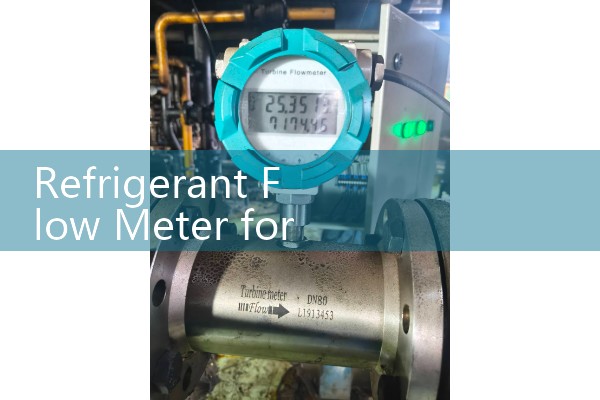
Last year a contractor in Vietnam installed a vortex meter right after a tight elbow on a 350 kW air cooled chiller. The flow signal was noisy and the BMS operator kept overriding the valve. We asked for a photo of the pipe run and immediately spotted the issue. After moving the meter to a straight section 20D downstream and adding a small flow conditioner, the signal smoothed out and the chiller EER improved by 6%. Simple fix, big impact.
Matching the Meter to Your Refrigerant Type
Choose wetted materials based on your refrigerant and oil. For R134a, R407C, and R410A with POE oil, 316L and PTFE O rings are standard and widely available. If the system runs R717 ammonia, switch to stainless steel construction with no copper alloys; we can supply full stainless Coriolis meters with Hastelloy C22 sensors on request. For CO2 transcritical booster systems, you need a meter rated for 90 bar and -35 °C; ask for our high pressure Coriolis variant rated to 100 bar.
Frequently Asked Questions
Q: Can I use an electromagnetic flow meter for liquid refrigerant?
A: No. Refrigerants and their compressor oils are non conductive. Magnetic flow meters need a minimum conductivity of 5 µS/cm. Use a Coriolis or vortex meter instead.
Q: What signal should I request for BMS integration?
A: The safest choice is 4-20 mA HART. It gives you flow rate plus temperature and density data over the same pair of wires. Modbus RTU via RS485 is also common and easy to wire into Carel, Siemens, or Delta controllers.
Q: How do I size the meter for a chiller plant?
A: Do not size by pipe DN alone. Send us your normal and maximum cooling load in kW or ton, condenser liquid temperature, and refrigerant type. We calculate the mass flow rate in kg/h and pick a meter that keeps velocity between 1 and 10 m/s. For most commercial chillers between 300 and 1500 kW, a DN25 or DN40 Coriolis fits well.
Q: Can the meter handle transient two phase slug flow?
A: Coriolis meters can briefly tolerate small bubbles, but sustained two phase flow degrades accuracy. Protect the meter with a simple liquid trap or a minimum 200 mm drop leg before the inlet. This is cheaper than a full separator.
Q: Do you supply meters with ATEX or IECEx certification?
A: Yes. Our Coriolis and vortex meters are available with ATEX Zone 1 or Zone 2 certifications for gas and dust. We have supplied certified units for hydrocarbon based chillers in Saudi Arabia and Nigeria. Specify the zone and gas group when you request a quote.
For a fast quotation, send your refrigerant type, pressure in bar, temperature range, pipe size in DN, and required flow range to [email protected]. You can also reach our engineers on Whatsapp at +86-25-52155837 or call +86-25-68650347. WeChat: +86 15365082610. We deliver to Southeast Asia, Oceania, Latin America, the Middle East, and Africa.
 Hot Product
 Related AD