

『Diesel Oil Flow Meter DN80 In-Line Blending Configurations』Related information(clamp on meter|electromagnetic meter|venturi meterrotameter|orifice meter|ultrasonic flow meter|mass flow meter|coriolis mass flow meter|coriolis flow meter|magnetic flow meter|magmeter flow meter|magflow flow meter|mag meter flow meter|electromagnetic flow meter|vortex flow meter|turbine flow meter|thermal mass flow meter|thermal flow meter|rotameter flow meter)
Diesel Oil Flow Meter DN80 In-Line Blending Configurations
Quick Answer
Silver Automation Instruments supplies DN80 diesel flow meters for in-line blending with oval gear or Coriolis technology. Common output signals are pulse, 4-20 mA HART, and RS485. A typical DN80 diesel line handles 8 m³/h to 80 m³/h at viscosity around 5 cP, with blending accuracy better than ±0.5%.
Why DN80 Fits Most In-Line Diesel Blending Skids
Blending diesel with additives, biofuel, or kerosene requires stable flow control. DN80 (3 inch) pipe is the sweet spot for medium-capacity blending skids across Southeast Asia and the Middle East. The line size balances pressure drop and turndown ratio. Without getting too technical, a DN80 full bore flow meter avoids bottlenecks. Many local EPCs in Vietnam, Indonesia, and Nigeria specify DN80 as a standard header size for diesel blending headers delivering 20,000 to 60,000 litres per hour.
Oval gear meters shine here. Diesel has natural lubricity, which protects the oval gears. Because the meter measures discrete pockets of fluid, viscosity shifts from temperature changes do not degrade accuracy the way they do in turbine meters. We have seen a paint manufacturer in Thailand switch from turbine to oval gear on a DN80 biodiesel blend line. Their batch consistency improved immediately. No more offset corrections on cold mornings.
Oval Gear vs Coriolis for Diesel Blending
Engineers often ask which technology wins. The answer depends on the blend recipe and budget.
A Silver oval gear flow meter (series OGF-DN80) with pulse output costs less and needs no straight pipe run. Accuracy holds at ±0.5% of reading across a 10:1 turndown. For a two-component diesel-additive blend, this is enough. You wire the pulse signal into a batch controller or PLC. Add a PT100 temperature probe if you need volume correction to 15 °C.
When the blend involves three or more streams with very different viscosities (for example diesel, heavy fuel oil, and a low-viscosity solvent), Coriolis mass flow becomes useful. Direct mass measurement in kg/h eliminates density guessing. A DN80 Coriolis meter from Silver Instruments outputs mass flow, density, and temperature simultaneously over 4-20 mA HART. The line remains compact, but the budget per point is higher. Most blending operators we work with in Latin America use coriolis for custody transfer blends and oval gear for internal process blends.
Typical Configuration Parameters
Here is a realistic bill of materials for a DN80 in-line diesel blending station using oval gear meters:
Pipe size: DN80 (88.9 mm OD), SCH 40 or SCH 80 carbon steel
Flow range: 8 to 80 m³/h (diesel at 20 °C)
Process connection: ANSI 150 RF flanges or JIS 10K, depending on the region
Wetted materials: Cast steel housing with aluminum oval gears and PTFE seals
Output: Quadrature pulse (NPN open collector), scaled pulse, and 4-20 mA HART active output
Power: 24 VDC loop power or 220 VAC with separate display
Hazardous area: ATEX Zone 1 / IECEx Ex ia IIC T4 optional, common for diesel blending rooms in the Middle East
Accessories: Integrated PT100 for API volume correction, M20 cable gland, stainless steel tag plate
Do not forget the air eliminator and strainer. Diesel transported over long distances picks up entrained air and pipeline debris. A 40 mesh Y-strainer and a float-type air re
Installation Points Engineers Usually Skip
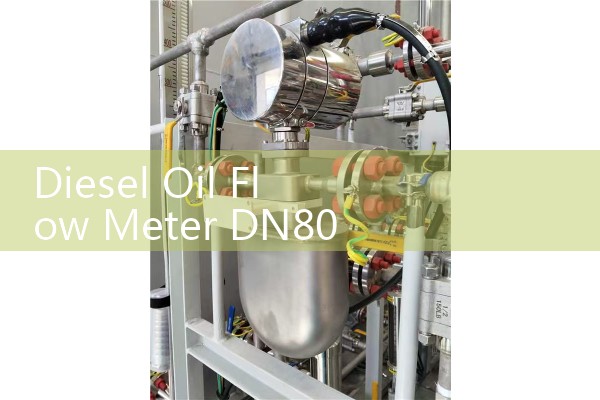
Mount the meter with the flow axis horizontal. The oval gears must sit in the horizontal plane to self-drain and avoid sediment build-up. In vertical DN80 lines, specify a special bearing configuration. We learned this the hard way on a Kenya depot project where vertical installation caused early bearing wear.
Another detail is back pressure. A DN80 oval gear meter needs at least 1.5 times the pressure drop plus vapour pressure at the meter outlet to prevent cavitation. For diesel at 40 °C, that is roughly 0.3 bar. Most blending systems already hold 2 to 5 bar downstream, so it is not a problem. But in suction-side placement, check the NPSH.
A Real Case: Lubricant Blending Plant in Vietnam
Last year a lubricant blender near Hai Phong contacted Silver Automation Instruments. They were upgrading a manual batch mixing system to in-line blending for engine oil and hydraulic oil bases. The product line used SN150 base oil with viscosity 30 cSt at 40 °C and a VI improver additive at 1200 cSt. Both streams used DN80 pipes, operating pressure 8 bar, temperature 35 to 45 °C.
We supplied two OGF-DN80 oval gear flow meters with 4-20 mA HART and local LCD displays. The pulse output went to a Siemens batch controller. Flow ranges were set at 15 to 70 m³/h for the base oil and 2 to 10 m³/h for the additive. Blend ratio accuracy stayed within 0.3% after calibration. The customer later added a third DN80 meter for a synthetic blend without changing the control cabinet. The skid footprint remained the same. This is the kind of straightforward scale-up that makes oval gear popular in Southeast Asia.
Frequently Asked Questions
What is the maximum flow rate for a DN80 diesel flow meter?
Typical maximum linear flow is 80 m³/h for diesel-like viscosity. At higher rates, pressure loss increases beyond 0.5 bar. For 100 m³/h, we recommend moving to DN100.
Can the DN80 meter handle biodiesel blends from B5 to B30?
Yes. Standard aluminum oval gears are compatible with B5 to B30. For B100, specify stainless steel gears and FKM seals to maintain chemical resistance.
Is multi-channel blending possible with one transmitter?
No. Each DN80 flow meter requires its own transmitter. A small PLC or RTU collects the signals from up to 6 meters. Silver Instruments can supply the complete panel drawing if you share the blend recipe.
How often should the oval gears be serviced in diesel service?
With a 40 mesh strainer and clean diesel, inspect gears every 18 months. In dusty yard environments, check and clean every 12 months. Gear replacement kits are stocked in our Dubai and Singapore hubs.
Do I need straight pipe runs for a DN80 oval gear meter?
No straight runs are required. The positive displacement design is immune to flow profile distortion. You can mount the meter after an elbow or valve, saving space on the blending skid.
Get a Quotation with Your Site Data
Send us your pressure (bar), temperature (°C), pipe size (DN), and flow range. Our application team will select the right oval gear or Coriolis model for your diesel in-line blending project. Mention the hazardous area zone if applicable. We typically reply with a dimension drawing and price within a working day.
 Hot Blog
 Related AD