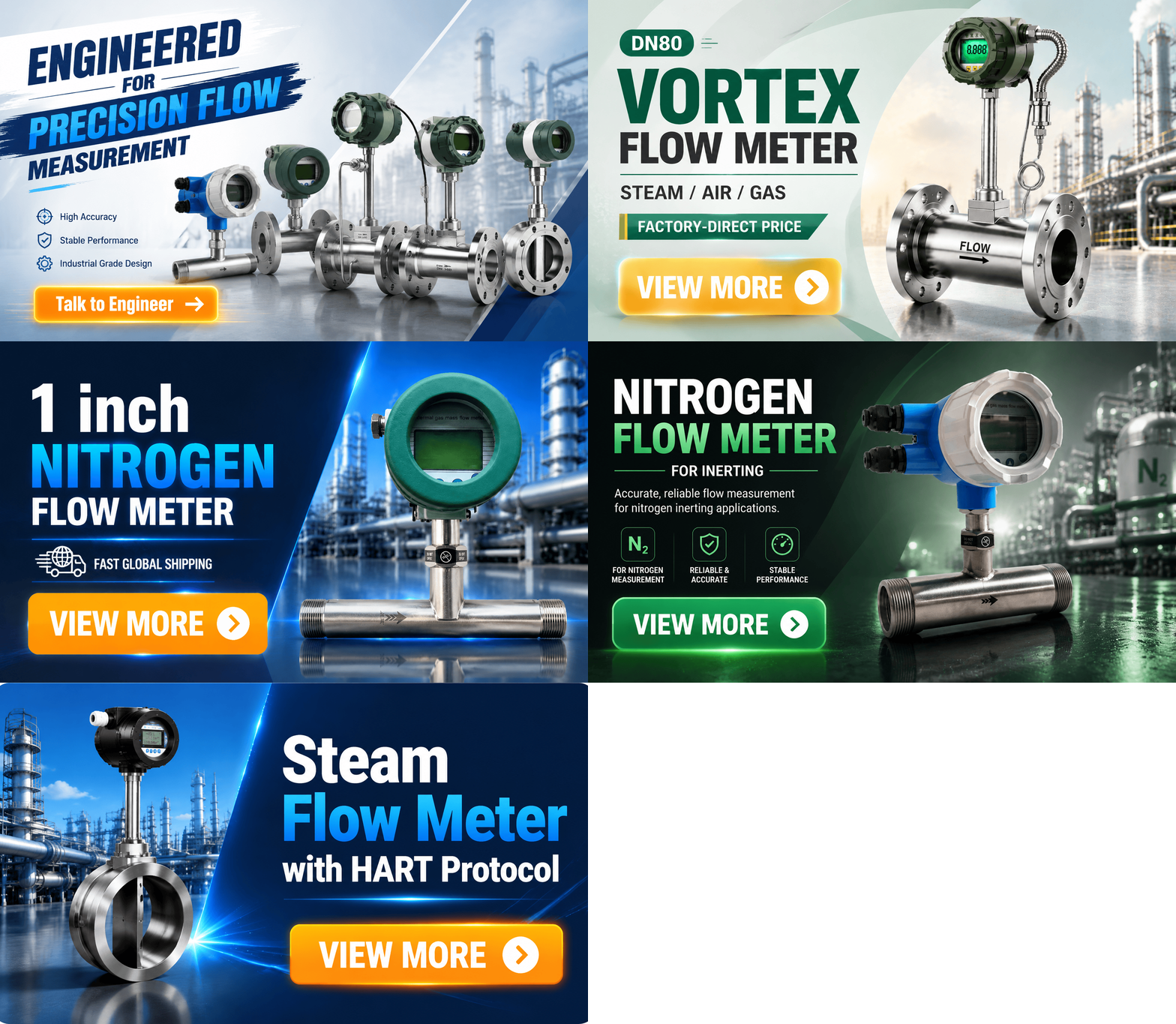


『Standard vortex flowmeter』Related information(clamp on meter|electromagnetic meter|venturi meterrotameter|orifice meter|ultrasonic flow meter|mass flow meter|coriolis mass flow meter|coriolis flow meter|magnetic flow meter|magmeter flow meter|magflow flow meter|mag meter flow meter|electromagnetic flow meter|vortex flow meter|turbine flow meter|thermal mass flow meter|thermal flow meter|rotameter flow meter)
What are the standard dimensions before and after installing the flowmeter? Before installing the flowmeter, the required length of the standard straight pipe section upstream and downstream may vary depending on factors such as the flowmeter type and pipeline conditions. For orifice flow meters, the length of the upstream straight pipe section is generally required to be 10 times the pipe diameter, and the downstream is required to be 5 times the pipe diameter. This is to allow the fluid to fully develop into a stable flow state before entering the flowmeter, reducing the impact of flow interference on measurement accuracy. For example, when installing an orifice flowmeter in a pipeline with a diameter of 100 millimeters, the length of the upstream straight pipe section should reach 1000 millimeters and the downstream should be 500 millimeters. Vortex flowmeters typically require an upstream straight pipe length of 15 to 20 times the pipe diameter and a downstream length of 5 to 10 times the pipe diameter. Because vortex flowmeters are commonly used to measure flow by detecting fluid eddies, a stable flow state is crucial for the formation and accuracy of eddies. Electromagnetic flow meters have relatively low requirements for upstream and downstream straight pipe sections, with a diameter of 5 times the diameter of the pipe when starting upstream and 3 times the diameter of the pipe when starting downstream. However, the specific standard dimensions will be specified in detail in the product manual of the flowmeter. When installing, it is necessary to strictly follow the requirements of the manual to ensure the accuracy and reliability of the flowmeters roll measurement. 2. Detailed explanation of the steps
The standard usage process for the Kaifeng Hexin vortex flowmeter (taking the mainstream LUGB series as an example) is divided into four core steps: installation and verification, on-site use, daily operation and maintenance, and troubleshooting. It is necessary to strictly follow its supporting factory instructions and JB/T 9248-2015 "Vortex Flowmeters" industry standard.
.1. Verification and preparation before installation (1) Appearance and accessory inspection 1 Check the nameplate parameters of the flowmeter body: confirm that the nominal diameter, nominal pressure, medium temperature range, output signal type match the on-site working conditions. The nameplate of Kaifeng Hexin will indicate the factory number and calibration date, and the calibration certificate needs to be retained. 2. Check that the sensor body is not bumped, the wiring terminals are not loose, the matching PTFE/metal sealing gasket is not deformed or damaged, and the signal cable meets the on-site explosion-proof/protection level requirements. The conventional model protection level of this brand is IP65, and the explosion-proof type is Exd II BT4. 3. Confirm that the preamplifier installation position of the split flowmeter is far away from strong electromagnetic interference sources such as frequency converters and high-power motors. (2) Condition matching verification 1 Verify the tested medium: Kaifeng and Xinxin vortex street flow meters are only suitable for clean gases, liquids, and steam. For media containing particulate impurities, a pre filter should be installed and inspected. For corrosive media, the material of the body should be confirmed to be 304/316L to match the operating condi
 Hot Blog
 Related AD