

 Current position > Product detail
『Standard plate orifice flowmeter』Related information(clamp on meter|electromagnetic meter|venturi meterrotameter|orifice meter|ultrasonic flow meter|mass flow meter|coriolis mass flow meter|coriolis flow meter|magnetic flow meter|magmeter flow meter|magflow flow meter|mag meter flow meter|electromagnetic flow meter|vortex flow meter|turbine flow meter|thermal mass flow meter|thermal flow meter|rotameter flow meter)
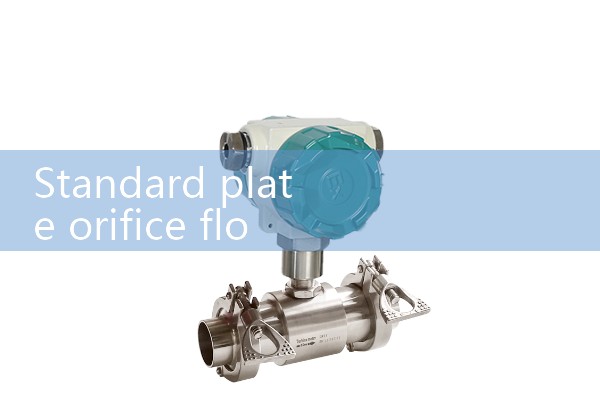
1. What kind of instrument does an orifice flowmeter belong to?
An orifice flowmeter belongs to a differential pressure flow instrument.
1. Instrument classification attributes: 1 The measurement principle is based on the pressure difference generated upstream and downstream when the fluid flows through the throttling element (orifice plate), and the flow rate is calculated by measuring the differential pressure value, which conforms to the Bernoulli equation and continuity equation principles. According to the national standard classification based on GB/T 2624-2006 "Measurement of full pipe fluid flow using differential pressure devices installed in circular cross-section pipelines for seepage control", the orifice plate flowmeter is clearly classified as a differential pressure ridge flow detection instrument.
2. Core Features 1 Structural composition • Throttling device: standard orifice plate (with circular hole thin plate) • Pressure sensing device: corner joint pressure sensing/flange pressure sensing • Differential pressure transmitter: measures pressure difference and outputs signal • Flow meter: converts flow rate based on differential pressure value 2 Technical parameters (data source: Metrology Technical Specifications released by the State Administration for Market Regulation in 2023) • Accuracy level: ± 1.0%~± 2.5% • Reynolds number range: 5 × 10 ³~1 × 10 ⁷ • Diameter range: DN50~DN1000 • Applicable media: gas, liquid, steam
III. Application restrictions • Large permanent pressure loss (about 50%~90% differential pressure value) • Strict requirements for straight pipe sections (above 10D and 5D) • Not suitable for viscous and solid particle media • Range ratio usually not excee
2. Flow formula of orifice flowmeter
The core flow formulas of orifice flowmeter are volume flow formula and mass flow formula, which are classic fluid measurement formulas based on differential pressure method.
The basic differential pressure flow formula (universal derivation form) is derived based on Bernoulli equation and continuity equation, and is the universal basic formula for all differential pressure flow meters:$$ Q = C_d \times \varepsilon \times A_0 \times \sqrt{\frac{2\Delta P}{\rho}}$$ The meaning of each parameter in the revised manuscript is as follows: - $C_d $: flow coefficient, determined by the structure of the orifice plate, fluid flow state, and Reynolds number. The flow coefficient of a standard orifice plate can be obtained from industry standards. - $\ varepsilon $: expansion correction coefficient, used to compensate for the volumetric expansion effect of compressible fluids (gases, steam). For incompressible fluids, the value is 1- $A_0 $: the cross-sectional area of the orifice plate opening, $A_0=\ frac {pi d ^ 2} {4} $, $d $is the diameter of the orifice plate opening, - $\ Delta P $: the static pressure difference before and after the orifice plate, taking the pressure at the upstream and downstream pressure taps of the orifice plate. Difference - $\ rho $: The density of the fluid in working condition is 2 Common formulas in segmented scenarios • Volume flow formula for incompressible fluids (liquids) At this time $\ varepsilon=1 $, the formula is simplified as: $$Q-v=C_d \ times \ frac {\ pi d ^ 2} {4} \ times \ sqr