

 Current position > News detail
『Refrigerant Coriolis Flow Meter: Multi-Variable Tracking for Simultaneous Density and Flow』Related information(clamp on meter|electromagnetic meter|venturi meterrotameter|orifice meter|ultrasonic flow meter|mass flow meter|coriolis mass flow meter|coriolis flow meter|magnetic flow meter|magmeter flow meter|magflow flow meter|mag meter flow meter|electromagnetic flow meter|vortex flow meter|turbine flow meter|thermal mass flow meter|thermal flow meter|rotameter flow meter)
Refrigerant Coriolis Flow Meter: Multi-Variable Tracking for Simultaneous Density and Flow
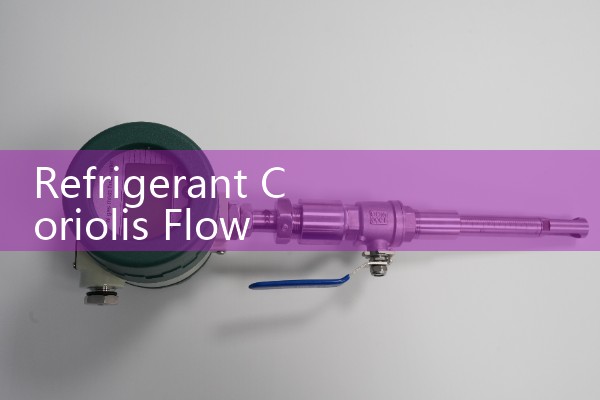
Quick Answer: A refrigerant Coriolis flow meter directly measures mass flow and fluid density in one device. You get real-time density readout alongside kg/h flowrate, which helps detect refrigerant composition shifts, subcooling conditions, or oil carry-over in HVAC and chiller test rigs. Silver Instruments offers refrigerant-rated Coriolis meters with secondary containment, down to DN15, and ATEX Zone 2 options for ammonia (R717).
Most engineers in chiller test labs or refrigerant filling stations know the pain. You need stable mass flow accuracy when the temperature swings from -30 °C to +60 °C. You also need to know if the refrigerant liquid has vapour pockets or if compressor oil diluted the mixture. A standard turbine or vortex meter cannot do that. A Coriolis meter can. And here is the part that gets overlooked: the same meter that outputs kg/h of R410A or R134a can also output density in kg/m³. This second variable is not a gimmick. It tracks real fluid quality changes during transient conditions.
We have seen this on a test bench in Malaysia last year. A heat pump manufacturer needed to confirm the exact subcooling margin at the condenser outlet. They used our SLW series Coriolis flow meter with a built-in PT100 temperature sensor. The meter gives mass flow, density, and temperature. Their PLC pulled the density reading via 4-20 mA HART. Every time the density shifted from 1106 kg/m³ to 1085 kg/m³ at the same temperature, they knew vapour was forming. That immediate insight saved them weeks of calibration drift chasing.
Here is the thing about refrigerant service. Many OEMs and compressor test labs spec a Coriolis meter but forget to specify the secondary containment or the burst pressure rating. High-pressure refrigerants like R32 or R410A can exceed 45 bar at ambient stop conditions. A standard process Coriolis meter rated for water at 16 bar is not enough. Silver Instruments configures sensors with stainless steel secondary containment, rated to 100 bar, and fully welded for tightness. This matters when your safety case goes to the end customer in Australia or Brazil.
One Meter, Three Variables: Mass Flow, Density, Temperature
A Coriolis flow meter uses oscillating tubes. The fluid inertia causes a phase shift proportional to mass flow. The resonant frequency shifts with fluid density. Because the electronics track both simultaneously, you get two primary process variables from one sensor. Add a built-in platinum RTD (PT1000 on some models) and you get temperature as a third variable. For refrigerant testing, this multi-variable output lets you cross-check the state of charge and detect non-condensable gases.
In practice, a commissioning engineer in the Middle East once told us their chiller acceptance test required measuring the refrigerant mass charge with 0.2% repeatability. They used a Coriolis meter from Silver Instruments between the receiver tank and the evaporator. Over 200 charge-discharge cycles, the meter caught density deviations that indicated nitrogen contamination from an incomplete vacuum pull. Without the density tracking, they would have blamed the flow sensor. Instead they purged the system and passed the acceptance test the next day.
Key Specifications for Refrigerant Applications
Our refrigerant Coriolis flow meters cover pipe sizes from DN15 to DN80. Typical accuracy is ±0.1% of rate for mass flow and ±0.0005 g/cm³ for density. Wetted parts are 316L stainless steel, with Hastelloy C22 available for ammonia (R717) or other aggressive refrigerants. Process connections can be threaded, flanged, or Tri-Clamp for clean systems. The electronics support 4-20 mA HART, pulse, Modbus RTU, and optional RS485 with density output. The ambient temperature range of the transmitter is -40 °C to +65 °C, and the fluid temperature range is -50 °C to +150 °C. ATEX Zone 1 and Zone 2 approvals are available for Ex d and Ex ia versions.
Why Density Tracking Matters More in Transient Operation
During a defrost cycle or a sudden load step, the refrigerant flow can flash inside the liquid line. A mass flow meter still measures correctly. But the density signal drops immediately. If your controller logic monitors densit
Installation Tips for Refrigerant Lines
Install the Coriolis sensor in the liquid line, not in the hot gas discharge, unless the meter is specifically rated for high-temperature gas. Ensure the pipe is full and avoid mounting at the highest point where vapour can collect. A downstream back pressure valve helps maintain single-phase liquid at the meter inlet. Most installers ignore this and then complain about zero drift. We recommend at least 3 bar back pressure on R134a lines and 5 bar on R32. Also, provide proper pipe supports because the Coriolis sensor is heavier than a typical inline flow meter. A loose mounting can introduce vibration noise into the mass flow output.
Communication and Integration with LabVIEW or PLCs
Since the meter provides multiple variables, you need a fast communication interface. Modbus RTU with floating point registers is common. One register for mass flow (kg/h), one for density (kg/m³), and one for temperature (°C). The Silver Instruments transmitter updates all values at 100 Hz internally, with a Modbus poll rate typically set at 10 Hz per variable. This is fast enough for most transient tests. For a pump test stand in Turkey, the engineer mapped the density value directly into their LabVIEW VI to calculate the real-time coefficient of performance (COP) of a scroll compressor running R407C. That data helped them fine-tune the economizer injection line size.
FAQ
Can a Coriolis meter measure refrigerant gas flow?
Yes, you can measure gas mass flow directly. However, the sensor must be sized for the lower density of gas. For suction line vapour at low pressure, you may need a smaller meter size to maintain enough tube oscillation amplitude. We often use a DN15 sensor for gas flows up to 30 kg/h of R134a vapour.
Does the density reading change with pressure?
Liquid refrigerants are slightly compressible. A density change from 5 bar to 20 bar is small but measurable. Our meters can detect density shifts of 0.1 kg/m³. If you need to compare readings against a refrigerant property database, you should correct for pressure. We can provide the raw density signal and let your PLC do the compensation.
What about oil in the refrigerant?
Oil mixed with refrigerant changes the mixture density. If you know the base refrigerant density and the oil density, you can estimate the oil concentration from the measured density. This is often used in compressor endurance test rigs. However, this requires stable temperature and known oil properties. It works best with POE oils and R410A.
Can I use a Coriolis meter for ammonia (R717)?
Yes, but you must select wetted materials compatible with ammonia. Standard 316L works for dry ammonia. For wet ammonia with possible stress corrosion cracking, we recommend Hastelloy C22 sensors. Also, the sensor needs ATEX Zone 2 or Zone 1 certification for ammonia vapour environments. Silver Instruments can supply this configuration.
What is the lead time for a refrigerant Coriolis meter?
Standard DN15 and DN25 meters with 316L wetted parts and 4-20 mA HART usually ship within 2 weeks. Custom ranges, Hastelloy materials, or ATEX certified versions typically take 4 to 6 weeks. Send us your refrigerant type, pressure and temperature range, pipe size, and flow range for a detailed quotation.
Need a quote or a test report?
Send us your refrigerant type (R134a, R410A, R32, R717, etc.), operating pressure in bar, temperature range, pipe size (DN), and your flow range in kg/h. We will return a configuration proposal with pressure drop calculation and wiring diagram.
Email: [email protected]
Tel: +86-135-1213-1526
Whatsapp: 86-135-12131526
WeChat: +86 13512131526